





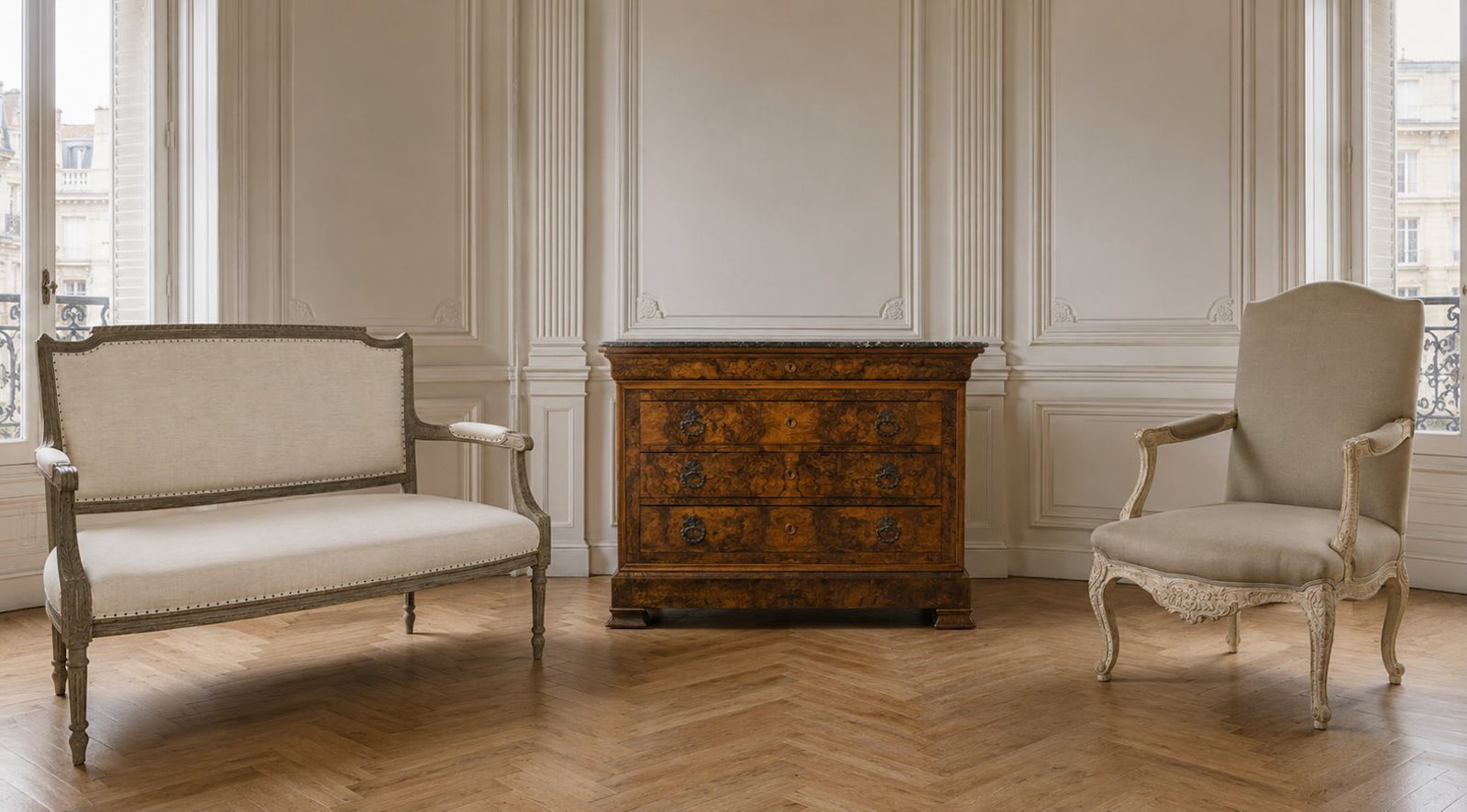
 Last spring, a French oak buffet came into the showroom. Kevin had picked it up from a farmhouse in Normandy. Based on the joinery and the density of the wood, he dated it somewhere around 1820.
Two hundred years old. Two world wars. The Spanish flu, COVID, and at least a dozen furniture trends it had the good sense to ignore. And there it was, standing in our showroom, absolutely solid, smelling faintly of old wood and something I can only describe as time.
That's the thing about antiques that doesn't get said enough. They've already proven they last. That is sustainability. Not a promise on a tag, not a certification, not a "responsibly sourced" footnote in a catalog. Two hundred years of evidence.
The furniture you buy today probably won't make it to 2035.
I say this not to be harsh, but because it's true and I think most of us already sense it. The sofa that photographs beautifully in a showroom. The dining table with the perfect matte finish. The credenza that arrives in six boxes and takes a Saturday to assemble. We buy it, we love it for a while, and then somewhere around year seven or eight, it starts to show its age in a way that feels cheap rather than charming. The veneer lifts. The drawer slides go. The finish clouds.
And so we start over.
Mass-produced furniture is designed around a purchase cycle, not a lifetime. The materials are engineered to look good, not to hold. Particleboard and MDF and veneers cut thin enough that the piece can be priced accessibly — which means it can be replaced when it fails, which it will. This is not an accident.
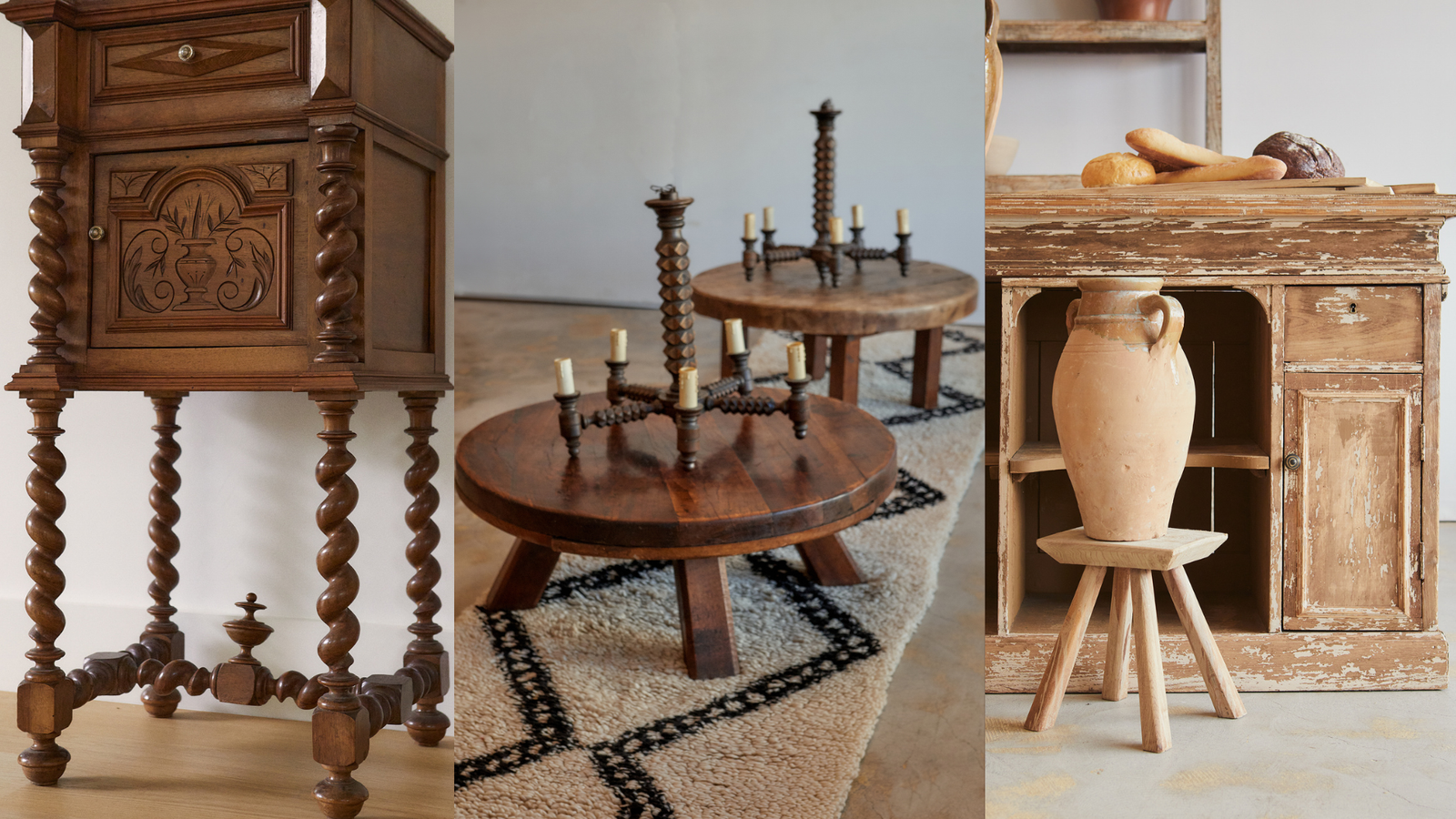
 An 18th century French armoire was built by a craftsman who expected it to outlive him. He used dense, slow-grown oak. He cut the joinery by hand, fit it tight enough that the piece could breathe and move with the seasons without splitting. He didn't use glue as a primary structural element. He didn't use staples. He built it the way you build something when you know your name is attached to it.
What Kevin sees when he looks at an old piece of wood.
Kevin has been doing this his whole life — literally, second generation, since 1973 — and one of my favorite things is watching him assess a piece. He'll look at the back of a drawer, run his hand along a joint, flip something over to check the underside. He can tell you the country of origin, the approximate period, and whether it's been restored or is original, just from the construction details.

What he always comes back to is the wood itself. Old-growth oak, cut before commercial forestry changed the density of the material. Trees that took 150 years to reach the size needed for a single plank. You cannot buy that wood today. It doesn't exist in the same way. Which means the structural integrity of an 18th century piece is, in a very real sense, irreplaceable.
No factory is producing something like it. No factory can.
The piece already exists. That counts for something.
When you buy a new sofa, something has to be made. Raw materials extracted, processed, assembled, finished, wrapped in plastic, loaded into a shipping container, moved across an ocean. When you buy an antique, none of that happens. The piece is already here. It already made that journey, two centuries ago, and it arrived.

Yes, we ship from Europe. Kevin and I make that trip together several times a year — sorting through farmhouses, brocantes, and estates, filling containers, and bringing pieces back. It's a family affair in every sense. But what we're moving already exists. We're not manufacturing something new. The difference in what that represents, in materials and energy and waste, is significant.
There's also the question of what happens to the money. A real antique holds its value. Often it grows. The buffet from Normandy — if you bought it from us today and decided to sell it in twenty years — would likely be worth more than you paid. A new piece from a mass retailer loses 40 to 60 percent of its value the moment it leaves the store. You're not buying furniture. You're renting it at full price.
None of this is a guilt argument. I'm not interested in making anyone feel bad about their sectional. But I do think there's something worth sitting with: the most intentional thing you can bring into your home might also be the most responsible one. A piece built to last another two hundred years, that your kids might actually want when you're gone, that tells a story just by existing in a room — that's not a purchase. That's a decision.
And in my experience, it's the decisions that last.
— Dina xx



Leave a comment (all fields required)