




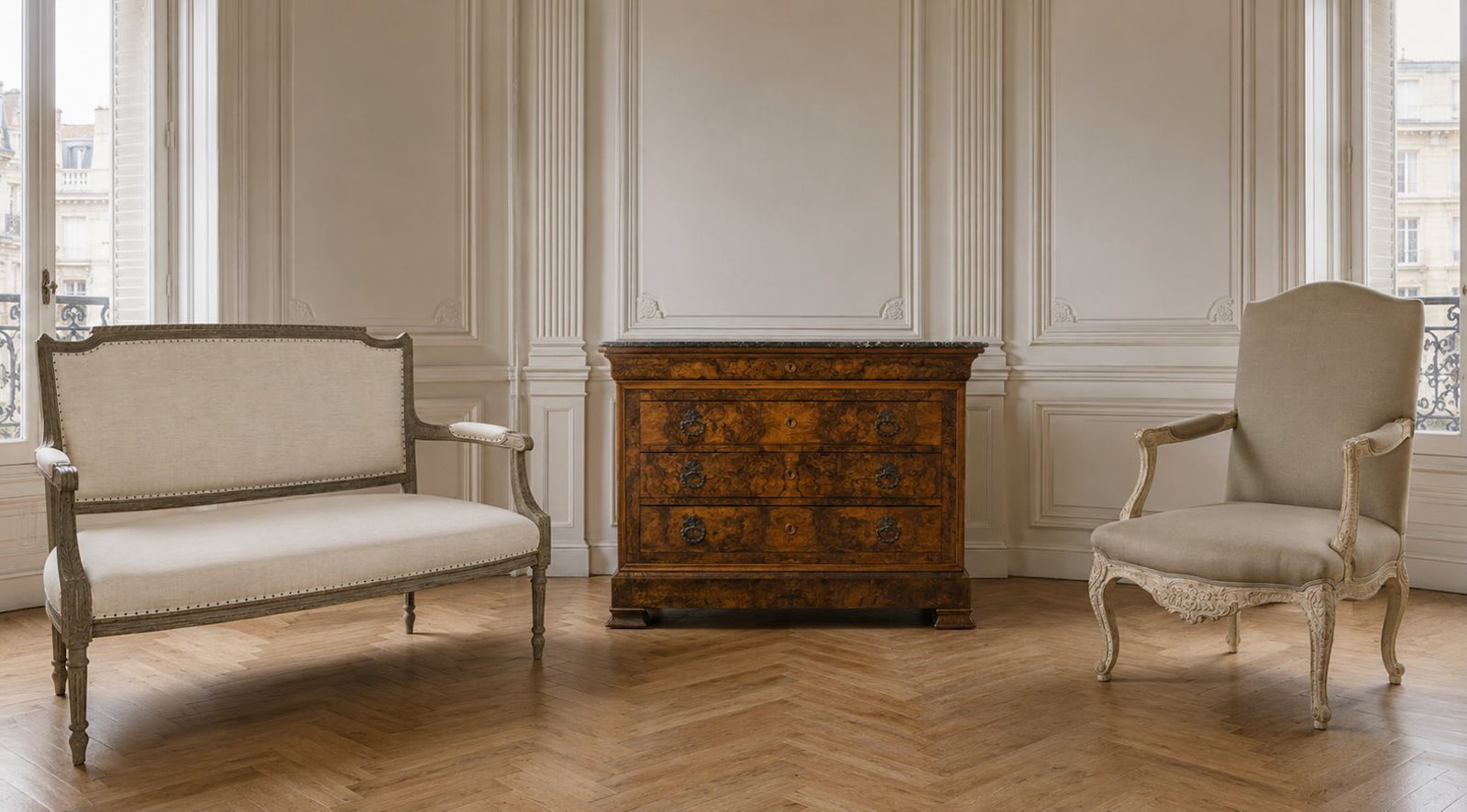

I get this question more than almost any other. A designer walks into the showroom, points at a chair, and says: "Is this Louis XV or XVI?" And honestly, the fact that they're asking means they're already ahead of most people. Because the three French Louis styles — XV, XVI, and Philippe — get blurred together constantly, even by people who should know better.
So here's the breakdown. No art history lecture. No footnotes. Just the things I look at after fifty-plus years of handling this furniture, and the things that'll help you tell them apart in about ten seconds.
Louis XV (roughly 1730–1770): The Romantic One

Louis XV is all curves. The Rococo influence is everywhere — shell motifs, scrolling acanthus leaves, asymmetrical carvings that look like they're mid-flourish. The legs are cabriole (think of a gentle S-curve), and they end in a scroll foot or sometimes a small pad. There's no straight line on the piece that didn't have to be straight. Everything flows.
The wood is usually walnut or fruitwood, sometimes beech for painted pieces. The ornamentation can be quite lavish — gilded bronze mounts, marquetry panels, carved flowers that feel almost alive. If you look at a Louis XV commode from the side, even the case itself bows outward. They call it a bombé form. It's a piece of furniture that refuses to stand still.
Dina's take: This is the romantic one. A Louis XV bergère in a modern living room is the equivalent of a red lip with jeans — it shouldn't work, but it absolutely does. I put them in white rooms, next to clean-line sofas, and they become the thing everyone sits in and never wants to leave. — Dina xx
Louis XVI (roughly 1770–1790): The One That Plays Well with Modern

Louis XVI is the reaction to all that Rococo exuberance. Neoclassicism was sweeping through France — the excavations at Pompeii had everyone obsessed with ancient Greece and Rome — and the furniture followed. The curves straightened out. The cabriole leg became a tapered, fluted column. The carvings became symmetrical, restrained, architectural: laurel wreaths, ribbons, rosettes, urns.
This is the style most designers instinctively reach for when mixing antiques into contemporary interiors, and there's a reason. The straight lines, the symmetry, the proportions — they echo modernist principles. A Louis XVI dining chair next to a Saarinen table? That works, and it works because both are driven by geometry and clean form, just two centuries apart.
The wood is often painted (gray, cream, pale blue) or gilded. When it's natural, it's walnut, mahogany, or oak. The construction is crisp. Tight. Precise. If Louis XV is a piece of music, Louis XVI is a piece of architecture.
Dina's take: This is the one that plays well with modern. It's my go-to for clients who say "I like antiques, but I don't want my house to look like a museum." A pair of Louis XVI fauteuils, reupholstered in something unexpected — a charcoal linen, a dusty pink velvet — and suddenly the whole room has a point of view. — Dina xx
Louis Philippe (roughly 1830–1870): The One People Walk Past and Shouldn't

Now here's where I get a little passionate. Louis Philippe furniture doesn't get the attention it deserves, and I think it's because it's not trying to impress you. There's no gilding. No elaborate carving. It's bourgeois furniture — made for the newly prosperous middle class during the reign of the "Citizen King" — and it shows in the best possible way. These pieces are about comfort, quality, and quiet dignity.
The hallmarks: rounded corners, smooth surfaces, dark woods (walnut, mahogany, sometimes cherry). The moldings are subtle — typically a simple ogee or cavetto profile. The hardware is often a turned wood knob rather than a brass pull. Everything about a Louis Philippe piece says live with me rather than look at me.
And the construction is extraordinary. This is some of the best-built furniture of the 19th century. The mortise-and-tenon joints are precise. The backs are often paneled rather than planked. The drawers glide. After 160, 170 years, these pieces work the way they were built to work.
Dina's take: This is the one people walk past and shouldn't. A Louis Philippe armoire is forever furniture in every sense. The rounded edges are gentle, warm — they work in bedrooms, they work in hallways, they work in kitchens as pantry storage. And the price point tends to be lower than XV or XVI, which means you're getting incredible quality for the investment. Don't sleep on Philippe. — Dina xx
The Quick Reference Chart
| Louis XV | Louis XVI | Louis Philippe | |
|---|---|---|---|
| Era | c. 1730–1770 | c. 1770–1790 | c. 1830–1870 |
| Movement | Rococo | Neoclassical | Bourgeois Romanticism |
| Leg Style | Cabriole (S-curve) | Straight, tapered, fluted | Turned or simple taper |
| Ornamentation | Lavish — shells, scrolls, asymmetrical carving | Restrained — laurel, ribbon, rosettes, symmetrical | Minimal — subtle moldings, rounded edges |
| Typical Woods | Walnut, fruitwood, beech (painted) | Walnut, mahogany, painted beech | Walnut, mahogany, cherry |
| The Vibe | Romantic, dramatic, feminine | Architectural, refined, versatile | Warm, honest, livable |
| Best Modern Pairing | Minimal white spaces, contemporary art, clean-line sofas | Mid-century modern, Scandinavian, anything geometric | Farmhouse modern, warm minimalism, layered neutrals |
How to Tell Them Apart in Ten Seconds
Look at the legs first. Always the legs. Curved and flowing? Louis XV. Straight, tapered, maybe fluted like a column? Louis XVI. Turned or gently tapered with no fluting? Probably Louis Philippe.
Then look at the overall silhouette. If the piece itself is curvy — the front bows, the sides swell — that's XV territory. If everything is straight and symmetrical, XVI. If the edges are rounded and the surfaces are smooth and uncarved, Philippe.
And if you're still not sure? That's what we're here for. Come see all three on our floor. Yes, we have all three. We always do. The best way to learn furniture is to touch it, sit in it, open the drawers, look at the back. I've been doing this since 1973 and I'm still learning something every time I pick up a new piece.
Bring your questions. That's what the showroom is for.



Leave a comment (all fields required)