

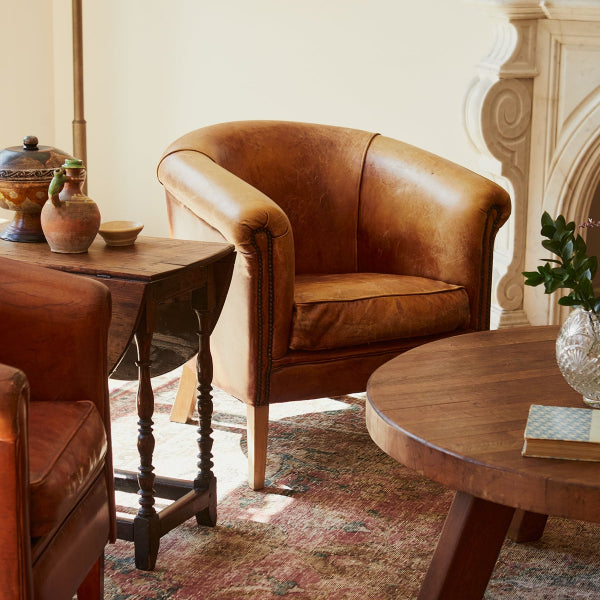


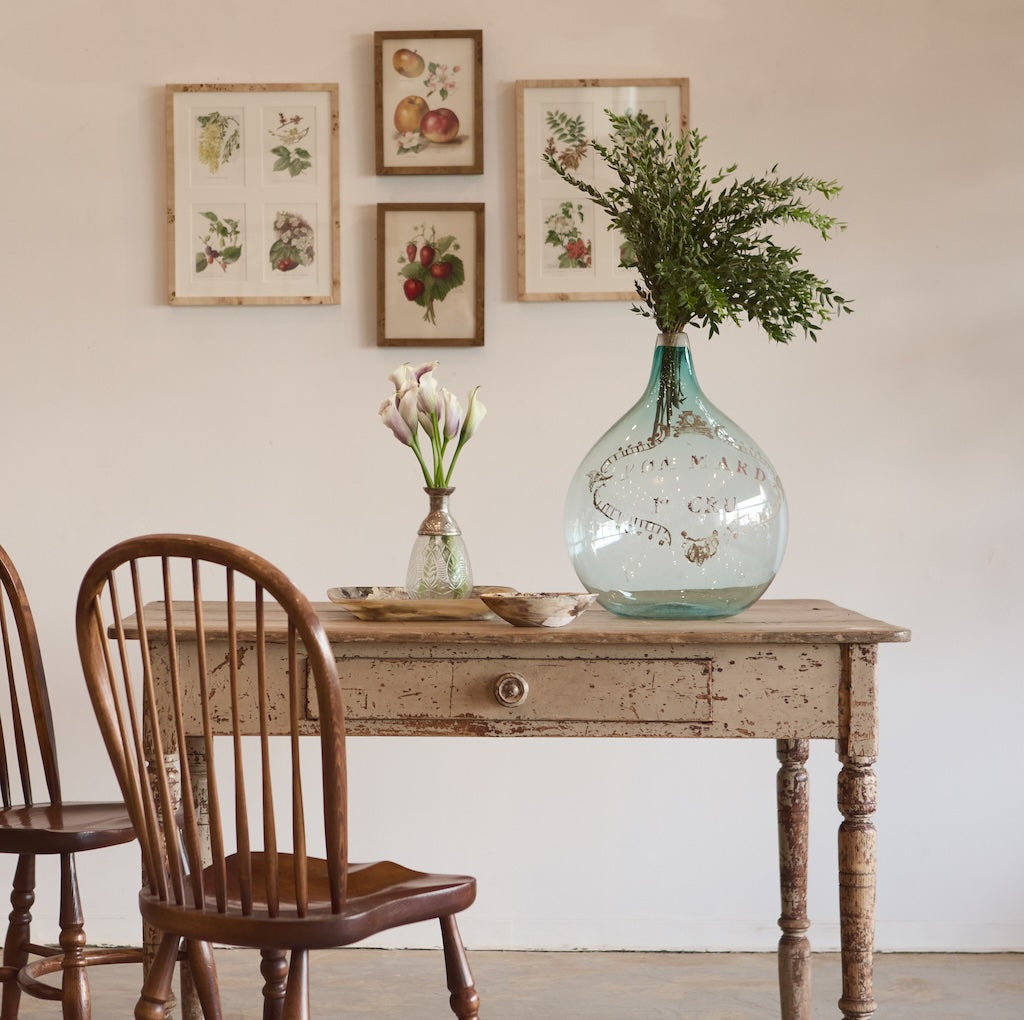

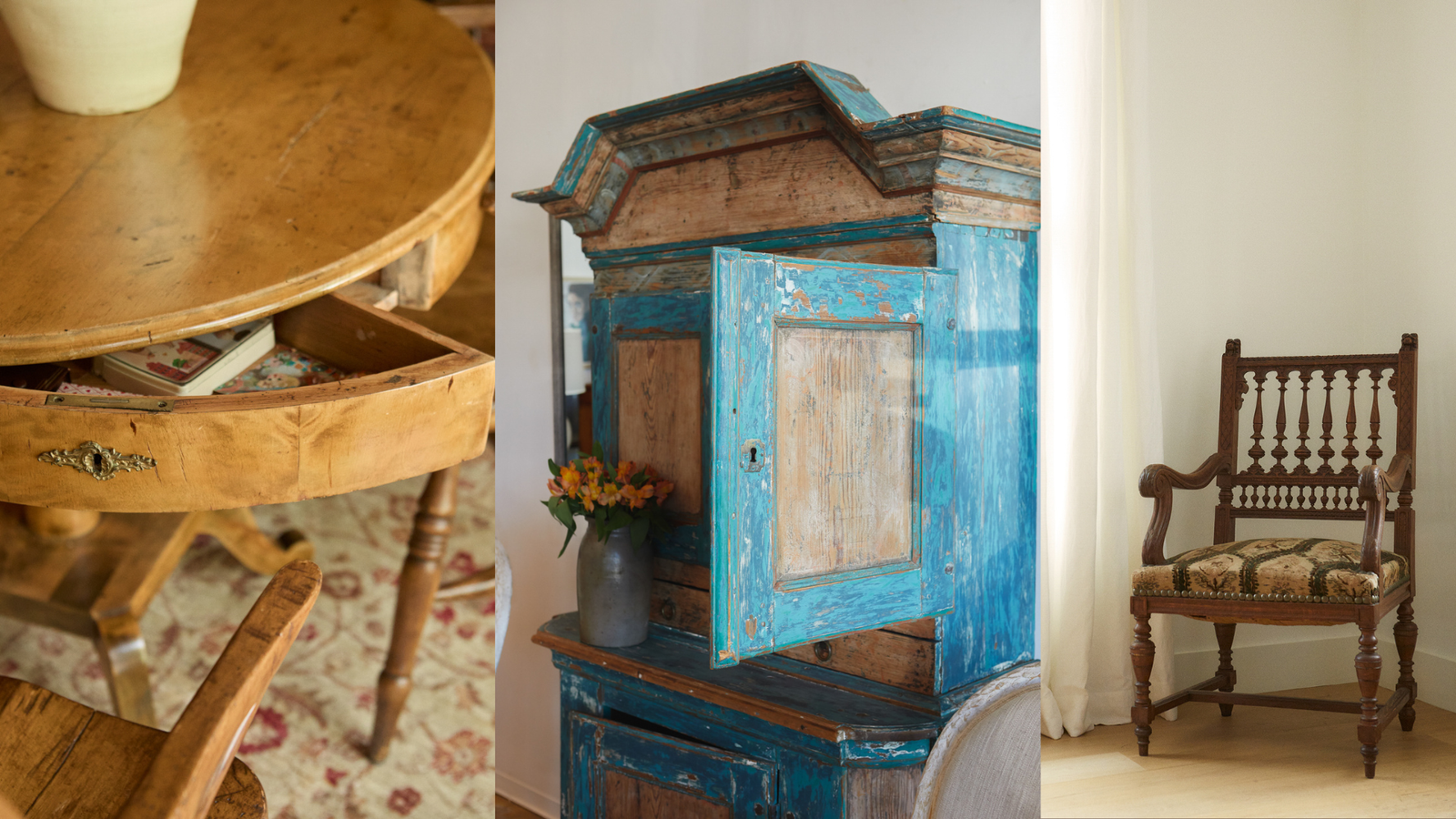


This is the question I get most often. Usually from someone holding a piece they're half in love with and half uncertain about.
They want the antique. They're just not sure it is one.
Fair. The market is full of reproductions that have been aged, distressed, stained, and sold as period pieces by people who know exactly what they're doing. After 50 years of family antiquing and 25 years in furniture manufacturing, I've developed what I call a five-point test. It won't catch everything — a skilled reproduction can fool even experienced dealers — but it will catch most fakes, and more importantly, it will give you real confidence when the genuine article is in front of you.
Here's how I look at a piece.
1. THE JOINERY

Turn the piece over. Open every drawer. Look at where the wood meets.
On genuine antique furniture, joints were cut by hand — dovetails, mortise-and-tenon, pegged connections. You'll see slight variations, subtle asymmetry, the marks of a craftsman working without a jig or a machine. The cuts are confident but imperfect. Each dovetail is a little different from the next.
On reproductions, especially anything made post-1950, joints were cut by machines. Router-cut dovetails are identical every single time — perfectly even spacing, perfectly uniform depth. That uniformity is the tell.
What to look for: irregular, hand-cut joints. Asymmetry is not a flaw — it's a date stamp.
2. THE HARDWARE

Original hardware on 18th and 19th century pieces was cast, not stamped. Take a bail pull or drawer pull and look at the back of it. Cast hardware has rough, unfinished backs — the mold line is visible, the metal is irregular. Stamped hardware (post-industrial) has smooth, uniform, clean backs.
Also look for the ghost. If a piece has had its hardware replaced — common over 200 years of use — there will be faint impressions, original screw holes, or slight variation in the finish around where old hardware used to sit. This is actually a good sign. It means the piece has been alive long enough to need new hardware at some point.
What to look for: rough-backed cast brass on original hardware, or evidence of original hardware placement on the surface.
3. THE WOOD

Old-growth wood is different from modern timber. Trees that were standing for three or four hundred years before being milled — which is what 18th and 19th century furniture was built from — grew slowly. Tight grain. Dense fibers. A quality of weight and solidity you feel when you pick up a piece.
Also look at the secondary wood: drawer bottoms, case backs, internal framing. On genuine period pieces, the secondary wood is also old-growth — unstained, showing natural aging, often a different species from the primary. On reproductions, secondary wood is modern: lighter, more uniform, sometimes still showing marks from a bandsaw instead of a pit saw.
What to look for: tight-grained, heavy primary wood and naturally aged (unstained) secondary wood.
4. THE PATINA

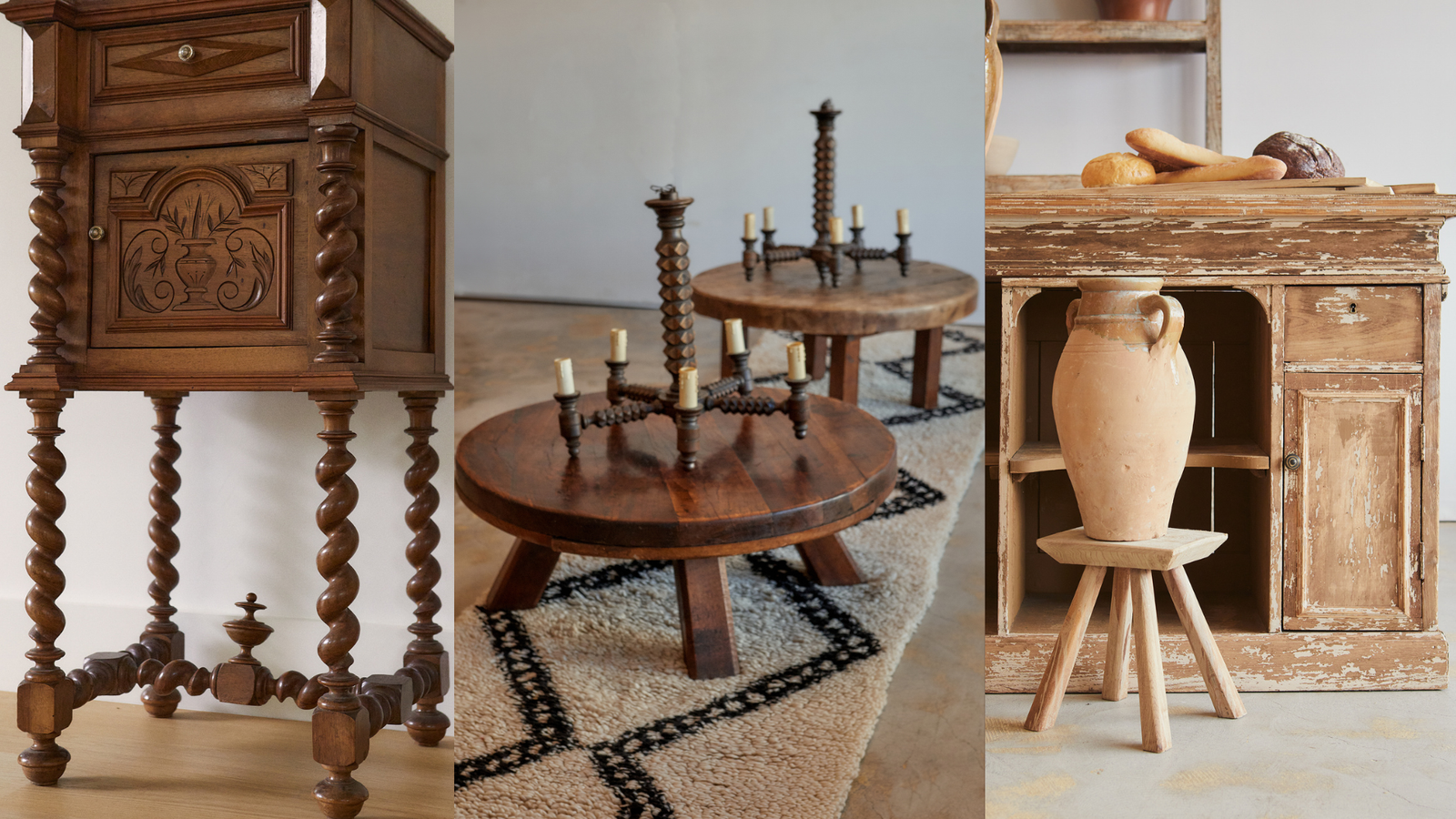
Real patina builds over a very long time. A hundred and fifty years of hands, light, use, and air creates something genuinely difficult to fake. It develops unevenly — darker in carved recesses and shadowed areas, lighter on high-contact zones like chair arms, stretchers, and drawer pull areas. It has depth. It looks earned.
Fake patina looks flat. Artificially aged pieces are stained uniformly, sanded to simulate wear, or spray-patinated. The wear ends up in the wrong places — on surfaces that would never have been touched, absent from places that would have been touched constantly. Fake wear is random. Real wear is logical.
What to look for: uneven depth, wear at logical contact points (edges, handles, feet, arms), not uniform surface-wide color.
5. THE PROPORTIONS

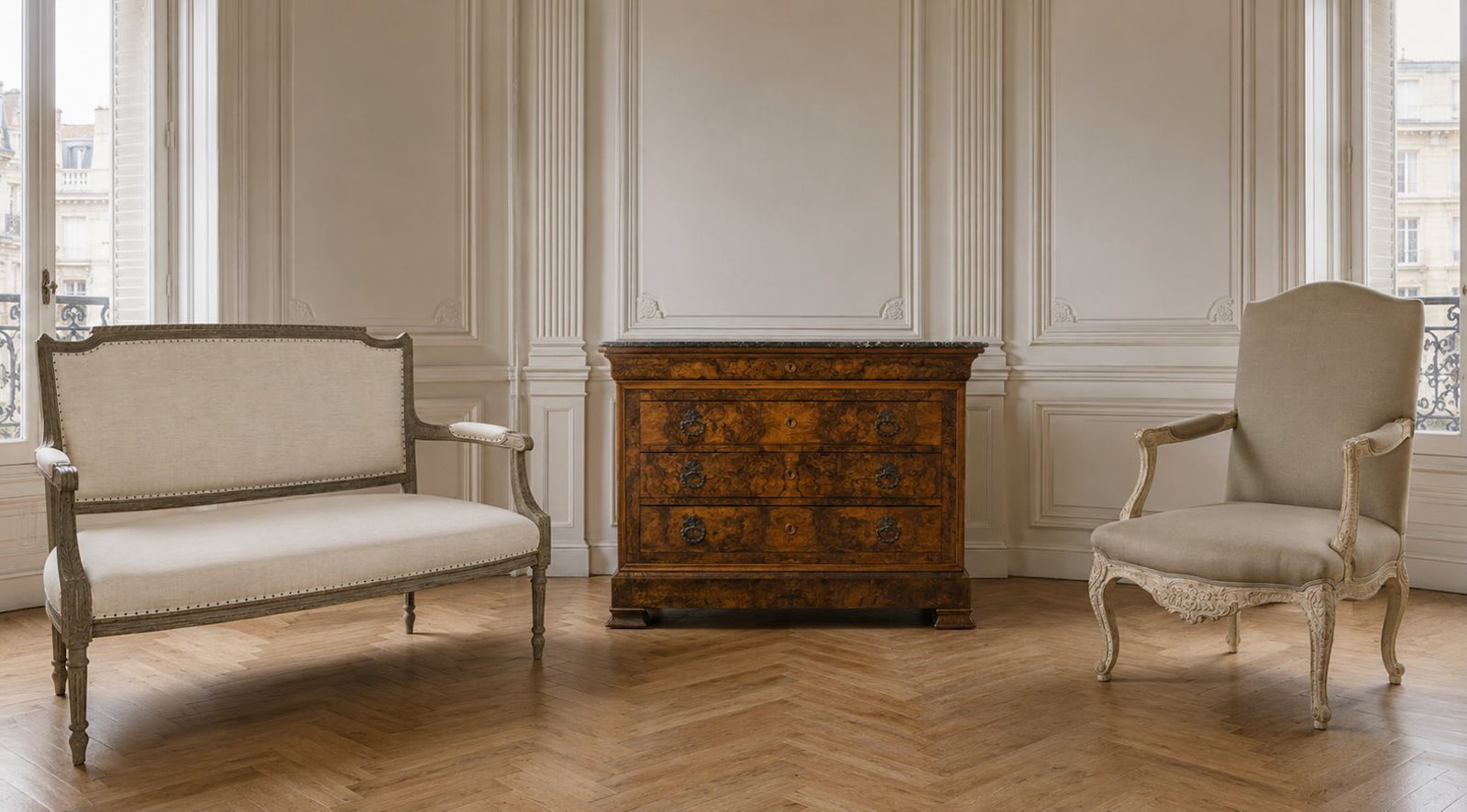
Each period had its own proportional sensibility, and it was very specific. Louis XV furniture flows — cabriole legs, rounded corners, organic curves. Louis XVI furniture is architectural — straight legs, geometric ornament, neoclassical restraint. Biedermeier is spare and sculptural. Victorian is heavier, more layered.
Reproductions usually get the style right but miss the proportions. The curves are slightly too pronounced or too shallow. The legs are a fraction too heavy or too light. The scale is off in a way that's hard to articulate but immediately felt by anyone who has spent time with genuine pieces.
What to look for: proportions that feel period-appropriate — not too fussy, not too heavy, calibrated to the aesthetic logic of the era.
WHAT THIS MEANS FOR OUR FLOOR

Every piece at Litt Concept House passes this test. Not because we run through a checklist — because 50 years of family expertise and 25 years in furniture manufacturing means we recognize when something is real the moment we're in front of it.
When you buy from us, you're buying the vetting. But now you know how to look yourself.



Leave a comment (all fields required)